


Venezuela’s Maduro Concludes Foreign Tour in Cuba for G77 + China Meeting
-
President Maduro called for the G77 plus China to lead a campaign at the
United Nations to end sanctions.
Showing posts with label foreign relations. Show all posts
Showing posts with label foreign relations. Show all posts
16 September 2009
28 August 2009
To Cuba NM Guv shows luv
The governor of the North American state of New Mexico, William Richardson, has spent the last week in Havana, selling New Mexican agricultural produce and possibly doing advance work for a changeTM in US foreign policy toward Cuba.

Here Richardson awkwardly connects with the Official Historian of the City of La Habana, Eusebio Leal. The small crowd of hangers on stand approvingly.

Here Richardson awkwardly connects with the Official Historian of the City of La Habana, Eusebio Leal. The small crowd of hangers on stand approvingly.
23 April 2009
15 February 2009
The US Blockade

Forty-seven years ago, President Kennedy initially erected the economic embargo that prevents commerce and travel to Cuba—and it has only stiffened with the ensuing US administrations. Depriving the island of its closest and most optimal trading partner has forced the Cuban government and its firms to incur the extra costs of buying and selling goods and services farther afield. Cuba can neither import needed medicine and scientific supplies, exploit the natural market for its tourism industry, nor often send its scientists, artists, and athletes to participate in events held in the US. In addition to the human suffering, the blockade has cost Cuba more than $86 billion over the course of its implementation.
Although limited agricultural cash sales to the island are now permissible, the US continues to lose out on over $3 billion per year due to the blockade. Its imposition divides families and impinges on US citizens’ constitutional freedoms to travel.
Medical Internationalism

To the wider world owe a debt both Cuba’s past (e.g. the descendents of Africa lead the independence charge) and future (e.g. the unification of Latin America will engender security and developmental benefits). And since Cuba’s well educated populace is its most valuable resource, it relies on human capital as a principal instrument of foreign exchange.
As such, Cuba’s foreign policy focuses heavily on loaning health and educational personnel to underdeveloped nations. Currently, 42,000 Cubans serve in 103 countries—responding to natural disasters, eradicating literacy, performing opthalmological surgery, and building public health capacity. Cuba also hosts without charge over ten thousand students from 113 different countries in its six year medical schools. These efforts demonstrate writ large the selflessness required for revolutionary socialism and create the favorable diplomatic relationships necessary to counteract the continued enmity from the US. However, some Cubans contend that the external emphasis has taken needed resources away from domestic health care—where it has now become customary to bring gifts to doctors to guarantee proper medical attention.
The Five Heroes

In the 1990s, as the Cuban state endeavored to build up tourism to fill the economic void left by the disappearance of Soviet supports, enemy exiles began a terrorist campaign targeting tourists. Cuba deployed counterterrorists to infiltrate South Florida groups and uncover criminal plots to bomb the island’s tourist facilities. The US caught and, in 2001, convicted five Cuban agents for conspiracy. Since then the “five heroes” have become widely celebrated in Cuba as revolutionary martyrs. The emphasis on their espionage as counterterrorism co-opts the terms of the US “war on terror” to wage a moral struggle for their release from US prisons. Currently, the US Supreme Court is deciding whether to hear their appeal, which contends that the trial venue of Miami did not ensure an unbiased jury. The case is the only judicial proceeding in US history to receive condemnation from the UN Human Rights Commission.
06 February 2009
05 December 2008
Can haz traid relashunz?
The X-Man met Castro.
Which caused Republicans to exit from the Hispanic Caucus.
Which may have contributed to the vast Democratic gains among Hispanics (after the immigration issue, of course).
Now Obama has chosen the X-Man as lead trade negotiator.
Just saying.
Which caused Republicans to exit from the Hispanic Caucus.
Which may have contributed to the vast Democratic gains among Hispanics (after the immigration issue, of course).
Now Obama has chosen the X-Man as lead trade negotiator.
Just saying.
28 November 2008
I Am (Uncle) Sam meets Yo Sí Puedo
A great gringo actor does mediocre journalism with Hugo Chávez & Raul Castro--but gets inadvertent scoop that Cuban president considers Guantanamo Bay a "neutral place".
Why would Raul Castro propose Guantanamo Bay as a neutral locale to meet with Obama?
Doesnt Cuba maintain claims of full legal possession of the entire island?
It seems to me that implying Guantanamo as neutral is tantamount to conceding Cuba's sovereign right to the area and saying its OK for the US military to continue to occupy it.
Explanation eludes.
Why would Raul Castro propose Guantanamo Bay as a neutral locale to meet with Obama?
Doesnt Cuba maintain claims of full legal possession of the entire island?
It seems to me that implying Guantanamo as neutral is tantamount to conceding Cuba's sovereign right to the area and saying its OK for the US military to continue to occupy it.
Explanation eludes.
16 November 2008
Deflated Exultation
Were it not for the flurry of forceful hurricanes that wiped out $10 billion (around a quarter of GDP) in housing, infrastructure, agriculture and other economic activity, Cuba might have been sitting rather pretty (at no less than 6% growth in GDP) during this moment in world history that sees capitalism catch a critical case of cyclical comeuppance.
Alas--due to natural forces wholly unrelated to socialist political economy--Cuba is not in a position to feel schadenfreude; it cannot freely shout that it told you so, let alone offer up its model as an alternative to the creatively destructive capitalists.
So the Cuban political leadership wryly watches the market states run around with their heads cut off (capital punishment?)--yet cannot speak, on the world stage, from a position of objective solvency.
Undaunted defenders of capitalism should be thankful that violent weather muted what otherwise might have stood as a formidable alternative for a world searching for a path forward.
Alas--due to natural forces wholly unrelated to socialist political economy--Cuba is not in a position to feel schadenfreude; it cannot freely shout that it told you so, let alone offer up its model as an alternative to the creatively destructive capitalists.
So the Cuban political leadership wryly watches the market states run around with their heads cut off (capital punishment?)--yet cannot speak, on the world stage, from a position of objective solvency.
Undaunted defenders of capitalism should be thankful that violent weather muted what otherwise might have stood as a formidable alternative for a world searching for a path forward.
11 November 2008
Mex med students just became most popular on campus
Thanks to advocacy by Mexico's workers party, DF will now give $300/month to every Mexican student in Cuba.
15 September 2008
"Latin America is Irrelevant"
On the morning of 11 September 2008, Luis Ernesto Derbez gave a keynote address at a Latin American conference on UNM's campus. Dr. Derbez was the Secretary of Economy and Secretary of Foreign Relations under former Mexican President Vicente Fox. He is currently the president of the University of the Americas in Mexico.
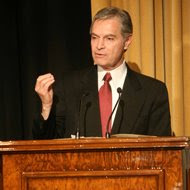
What follows is an English-language paraphrasing of Dr. Derbez's speech. The words are mine, but the concepts, structure and examples are from his address. In only a few places have I editorialized, and those thoughts appear parenthetically and italicized. This essay tries to reflect the content of Dr. Derbez's speech; I take full blame for any unintentional misrepresentations.
Derbez began his speech with the declaration that Latin America is irrelevant. The continent is irrelevant on the world stage of geopolitics. That is, it does not have an influential voice in major world decisions.
For starters, Latin America is not represented on the UN Security Council, an agenda setting body with overwhelming veto power. Another among myriad examples of Latin America's irrelevance is that its participation in the failed Doha Round was largely marginal, with Brazil playing a small but inconsequential role.
Latin America is irrelevant because, in this emergent multi-polar world, it has not sufficiently integrated to constitute a major block that can articulate its shared interests in a forceful and coherent way. As they engage in diplomatic negotiation and statecraft, the prepotent regional poles of power do not have to seriously heed Latin America as an equal. The formidable positions of the US, the European Union, the Russia Federation, China and India demand careful consideration by all parties. Latin America, on the other hand, has not achieved such status due to its incomplete integration.
Derbez says that the obstacles to integration stem from three situations currently encountered in Latin America: disagreement and competition among divergent models of integration, the failures of Latin American businesses, and the still wanting democratic character of Latin American nations.
As Latin America confronts the need to integrate, its various players have initiated different models for regional integration. First there is the NAFTA model, which represents the traditional posture of turning towards the US. Because of an entangled history and geographic determinism, Mexico is torn between this US-centric model and one that looks south for alliances. The problem with the NAFTA model is that it would necessarily subordinate a Latin American block to the North American block in global interactions.
An alternative option for integration is MERCOSUR, which is the South American free trade organization spearheaded by Brazil. Although its locus of power is decidedly southern, it is similar to NAFTA in that it remains trade focused and relies on nation-states as the units of membership.
The third model of Latin American integration is represented by ALBA, the "Bolivarian" alternative to the Free Trade Area of the Americas, rolled out by Venezuela and Cuba, and now counting Nicaragua and Bolivia as members. ALBA differs from the traditional country constituted and trade focused alliances in that it involves people-to-people integration on energy, education and health issues. Overlooking national boundaries and integrating populations rather than markets, ALBA is a decidedly Marxist model, says Derbez.
The disagreement on which model to follow has, in part, prevented Latin America from more fully integrating, and thus from developing a unified voice that commandingly advocates for the region's common interests on the world stage. Curiously, Derbez notes, the three-way divergence that has stalled integration on the continental level is reminiscent of the fractious tripartite conflict found in Mexico's domestic politics, where the PRI, PAN and PRD regularly enter into intense gridlock.
Derbez proposes that if a consensus model of integration is not arrived at, then it may be up to the business sector to exert Latin America's influence on the world. The problem with the so-called multilatinas is that they are generally more dedicated to distribution than to innovation. Suitable examples are found in Mexico where some of the most successful companies distribute telecommunication goods and services or specialize in rational distribution of food products, but do not invent novel technology. Until Latin American industry begins to offer revolutionary products, it will remain on the margins of the world's balance sheets and attention spans. (Interestingly, where international business is involved, Derbez does not express the same discomfort about borderless integration that he did in reference to the ALBA case. Implicitly, Derbez seems to approve of capital ignoring political borders, but frowns on social movements doing so.)
A final characteristic of Latin America that impedes regional integration, common cause, and unity of purpose is the anti-democratic tendencies still found among the continent's political leadership. Derbez points out that the excesses of presidentialism still rear their ugly heads.
Supposedly, Latin American citizens have confidence in strong leaders that make firm decisions, regardless of whether they violate institutional norms. So we see Latin American presidents acting increasingly dictatorially, in defiance of constitutional limitations and other branches of government. Examples include Hugo Chavez reconstituting Venezuela's Supreme Court and proposing an end to term limits, and Alvaro Uribe gaining extra terms by meddling with the legislative and judicial branches. Derbez takes pains to note that this anti-democratic nature finds expression in both right wing and leftist administrations. (However, Derbez fails to explain why such an anti-democratic trend occurs especially in Latin America. This makes his contention rest rather shakily on a premise of discredited essentialism.)
This anti-democratic prong of Derbez's thesis seems to assert that as long as domestic institutions remain weak, designs for integrationist institutions will not gain traction.
Despite the impassioned rhetoric and strategic vision exhibited by Latin American leaders, the region has yet to integrate effectively. Disagreements over the route to follow—on whether to take the form of a common market or to adopt a more humanist community model, on whether to adopt a US-centric perspective or a more southerly orientation—have delayed the realization of Nuestra America. Also, the failure of Latin American businesses to develop a reputation for innovation has prevented that sector from serving as an influential de facto representative of the area's mutual interests. Finally, the disregard for democratic institutions at the national level has not only further entrenched political stereotypes about the region, but also slowed progress towards the formation of hemispheric institutions. According to Derbez, the totality of these dilemmas has obstructed the path to integration.
However long Latin America continues to be fragmented, it will not be able to formulate coherent claims on the world stage; it will not command the deference given to other major power blocks in the prosecution of international affairs. In a word, Latin America will remain irrelevant.

What follows is an English-language paraphrasing of Dr. Derbez's speech. The words are mine, but the concepts, structure and examples are from his address. In only a few places have I editorialized, and those thoughts appear parenthetically and italicized. This essay tries to reflect the content of Dr. Derbez's speech; I take full blame for any unintentional misrepresentations.
LATIN AMERICA IS IRRELEVANT
Derbez began his speech with the declaration that Latin America is irrelevant. The continent is irrelevant on the world stage of geopolitics. That is, it does not have an influential voice in major world decisions.
For starters, Latin America is not represented on the UN Security Council, an agenda setting body with overwhelming veto power. Another among myriad examples of Latin America's irrelevance is that its participation in the failed Doha Round was largely marginal, with Brazil playing a small but inconsequential role.
Latin America is irrelevant because, in this emergent multi-polar world, it has not sufficiently integrated to constitute a major block that can articulate its shared interests in a forceful and coherent way. As they engage in diplomatic negotiation and statecraft, the prepotent regional poles of power do not have to seriously heed Latin America as an equal. The formidable positions of the US, the European Union, the Russia Federation, China and India demand careful consideration by all parties. Latin America, on the other hand, has not achieved such status due to its incomplete integration.
Derbez says that the obstacles to integration stem from three situations currently encountered in Latin America: disagreement and competition among divergent models of integration, the failures of Latin American businesses, and the still wanting democratic character of Latin American nations.
As Latin America confronts the need to integrate, its various players have initiated different models for regional integration. First there is the NAFTA model, which represents the traditional posture of turning towards the US. Because of an entangled history and geographic determinism, Mexico is torn between this US-centric model and one that looks south for alliances. The problem with the NAFTA model is that it would necessarily subordinate a Latin American block to the North American block in global interactions.
An alternative option for integration is MERCOSUR, which is the South American free trade organization spearheaded by Brazil. Although its locus of power is decidedly southern, it is similar to NAFTA in that it remains trade focused and relies on nation-states as the units of membership.
The third model of Latin American integration is represented by ALBA, the "Bolivarian" alternative to the Free Trade Area of the Americas, rolled out by Venezuela and Cuba, and now counting Nicaragua and Bolivia as members. ALBA differs from the traditional country constituted and trade focused alliances in that it involves people-to-people integration on energy, education and health issues. Overlooking national boundaries and integrating populations rather than markets, ALBA is a decidedly Marxist model, says Derbez.
The disagreement on which model to follow has, in part, prevented Latin America from more fully integrating, and thus from developing a unified voice that commandingly advocates for the region's common interests on the world stage. Curiously, Derbez notes, the three-way divergence that has stalled integration on the continental level is reminiscent of the fractious tripartite conflict found in Mexico's domestic politics, where the PRI, PAN and PRD regularly enter into intense gridlock.
Derbez proposes that if a consensus model of integration is not arrived at, then it may be up to the business sector to exert Latin America's influence on the world. The problem with the so-called multilatinas is that they are generally more dedicated to distribution than to innovation. Suitable examples are found in Mexico where some of the most successful companies distribute telecommunication goods and services or specialize in rational distribution of food products, but do not invent novel technology. Until Latin American industry begins to offer revolutionary products, it will remain on the margins of the world's balance sheets and attention spans. (Interestingly, where international business is involved, Derbez does not express the same discomfort about borderless integration that he did in reference to the ALBA case. Implicitly, Derbez seems to approve of capital ignoring political borders, but frowns on social movements doing so.)
A final characteristic of Latin America that impedes regional integration, common cause, and unity of purpose is the anti-democratic tendencies still found among the continent's political leadership. Derbez points out that the excesses of presidentialism still rear their ugly heads.
Supposedly, Latin American citizens have confidence in strong leaders that make firm decisions, regardless of whether they violate institutional norms. So we see Latin American presidents acting increasingly dictatorially, in defiance of constitutional limitations and other branches of government. Examples include Hugo Chavez reconstituting Venezuela's Supreme Court and proposing an end to term limits, and Alvaro Uribe gaining extra terms by meddling with the legislative and judicial branches. Derbez takes pains to note that this anti-democratic nature finds expression in both right wing and leftist administrations. (However, Derbez fails to explain why such an anti-democratic trend occurs especially in Latin America. This makes his contention rest rather shakily on a premise of discredited essentialism.)
This anti-democratic prong of Derbez's thesis seems to assert that as long as domestic institutions remain weak, designs for integrationist institutions will not gain traction.
Despite the impassioned rhetoric and strategic vision exhibited by Latin American leaders, the region has yet to integrate effectively. Disagreements over the route to follow—on whether to take the form of a common market or to adopt a more humanist community model, on whether to adopt a US-centric perspective or a more southerly orientation—have delayed the realization of Nuestra America. Also, the failure of Latin American businesses to develop a reputation for innovation has prevented that sector from serving as an influential de facto representative of the area's mutual interests. Finally, the disregard for democratic institutions at the national level has not only further entrenched political stereotypes about the region, but also slowed progress towards the formation of hemispheric institutions. According to Derbez, the totality of these dilemmas has obstructed the path to integration.
However long Latin America continues to be fragmented, it will not be able to formulate coherent claims on the world stage; it will not command the deference given to other major power blocks in the prosecution of international affairs. In a word, Latin America will remain irrelevant.
Subscribe to:
Posts (Atom)